
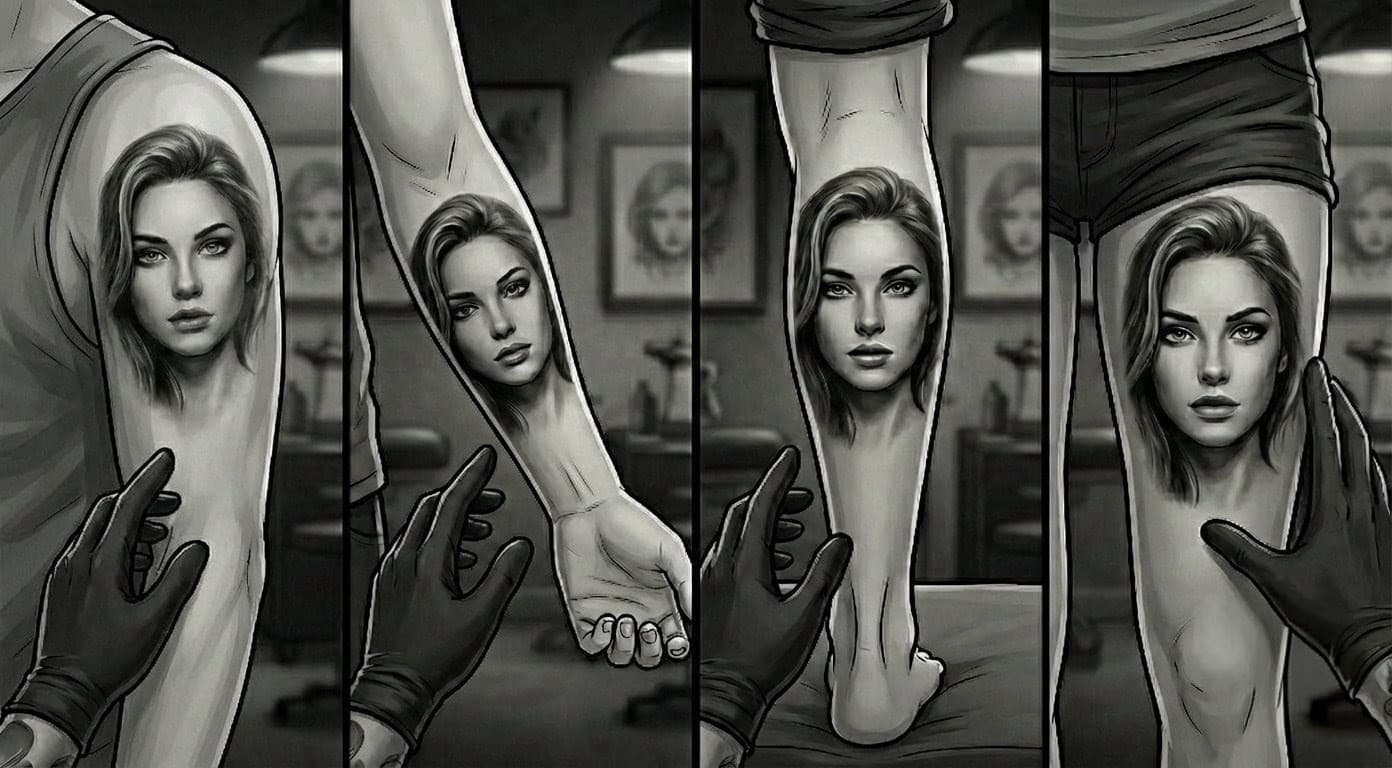
Realism needs a flat canvas. Here is why the bicep, forearm, calf, and thigh are the only placements I recommend for portraits—and which one is right for you.
When it comes to realistic portrait tattoos, placement isn't just about where you want the tattoo; it's about where the tattoo works.
A portrait is a 2D image. Your body is a 3D object that curves, twists, and stretches. If you put a face on a part of the body that wraps too much (like the ribs or a skinny wrist), the face distorts. The eyes look weird, the nose bends, and the whole thing looks "off."
To get that photo-real quality, we need a relatively flat, stable surface. Here is my breakdown of the best spots for realism.
This is the gold standard for a reason. It offers a nice, large, relatively flat area that doesn't twist much when you move your arm.
This is arguably the most popular spot for memorial portraits. It’s right there—you can see it every day without looking in a mirror.
For larger portraits or animal realism (like a lion or tiger), the calf is king.
If you want a large-scale piece with zero distortion, the front or outer thigh is the place.
I am honest about what works. I will generally refuse to put a realistic portrait on:
A final rule of thumb: Faces need space. If you try to shrink a portrait down to the size of a postage stamp, it will turn into a blob within five years. To get the realism, we need to go decent size—at least palm-sized or bigger.
Unsure where your idea will fit best? Come in for a consultation, and we can stencil it up to see exactly how it sits.